
What Advantage Does the Twisted Design Give 12mm Polypropylene Fiber?
Twist a strand of fiber, and you change more than its shape — you change how hard the surrounding concrete has to work to pull it back out once it’s locked in. That’s the whole idea behind our 12mm twisted polypropylene fiber. Instead of a smooth, straight surface, the filament has a helical twist running along its length, which creates a mechanical anchoring effect inside the cement matrix. As a PP Fiber Manufacturer, we recommend this variant specifically to contractors who need something with more bite than a standard straight or monofilament fiber, without stepping all the way up to a full macro synthetic product.
Essentially, this twist makes it such that the concrete has to hold on to the fiber from a surface that is not flat but rather curved in a spiral fashion, meaning greater mechanical resistance will be created if a crack tries to dislodge the fiber.
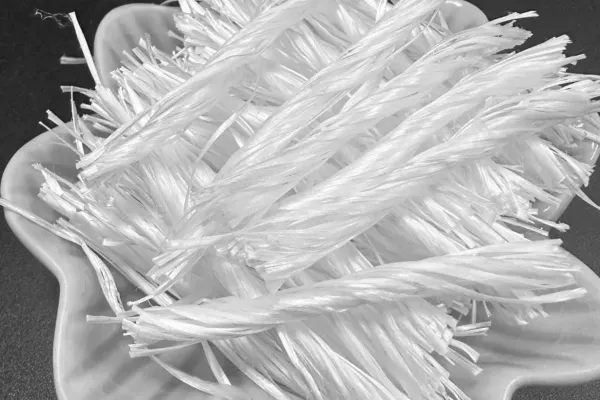
Product Overview
This fiber is manufactured from virgin PP micro fiber, with the twist introduced during the extrusion process itself rather than added afterward, which keeps the twist consistent and prevents it from unwinding during mixing or transport. As a dedicated PP Micro Fiber Manufacturer, we control twist frequency and filament diameter closely, since an inconsistent twist pattern can actually reduce the bonding advantage this fiber is designed to offer.
Technical Specifications
| Fiber Structure | Twisted |
| Brand | Fiberwell |
| Alkali Resistance | Standard |
| Fiber Length | 12 mm |
| Tensile Strength | 600 MPa |
| Melting Point | 160°C |
| Size Classification | Macro |
| Density | 0.9 g/cm3 |
Key Features
The twisted profile improves mechanical anchorage within the concrete matrix, giving this fiber better resistance to being pulled out once a crack starts to form — which is really the whole point of using a twisted variant over a straight one. It still disperses well through the mix despite the added surface texture, though it does require slightly more attention during mixing compared to straight fiber to avoid localized clumping at high dosages. Like the rest of our range, it’s fully corrosion-proof and alkali-resistant, so long-term durability isn’t a concern even in demanding environments.

Recommended Dosage
For applications needing improved crack-bridging strength industrial flooring, pavements, or higher-traffic slabs a dosage of 0.9–1.3 kg per cubic meter is generally recommended. Where load conditions are particularly demanding, dosage can be pushed toward 1.5 kg per cubic meter, though it’s worth confirming with our technical team rather than guessing, since the twisted design behaves a bit differently in the mix than straight fiber at equivalent dosages.
Mixing Compatibility
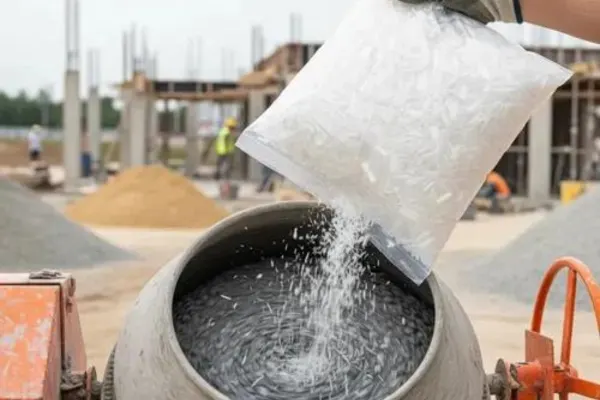
Works well in ready-mix concrete and site-batched concrete, though slightly longer mixing time is sometimes recommended at higher dosages to ensure even dispersion given the textured surface. Compatible with standard admixtures including plasticizers and curing compounds.
FAQ
What does the twist in this fiber actually do?
It creates mechanical anchoring within the concrete, so the fiber resists being pulled out of the matrix more effectively than a smooth straight fiber would at the same length.
Does twisted fiber need longer mixing time than straight fiber?
At higher dosages, slightly extended mixing time can help ensure even dispersion, though at standard dosages the difference is minimal.
Is twisted fiber a good alternative to macro synthetic fiber?
For moderate structural demands, yes, though for heavier load-bearing applications, dedicated macro synthetic fiber is usually still the stronger choice.