
Why Choose 8mm Monofilament Polypropylene Fiber for Thinner Concrete Sections?
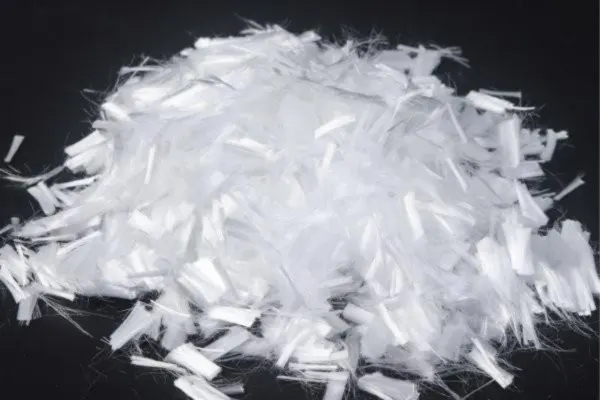
Not all slabs are 150 mm thick, because thin screeds, plastering coats, thin overlays, and some precast panels are thinner and thus behave differently in terms of shrinkage and cracking than regular slabs. That’s where 8mm monofilament polypropylene fiber earns its place in our range — short enough to work cleanly in thin sections, long enough to still do real crack-control work. As a PP Fiber Manufacturer, this is one of the sizes contractors reach for most often when the job calls for something a little more refined than the standard 10mm or 12mm fiber.
The logic is straightforward. When the fiber in the plastering coat or thin screed is relatively long, it will come through to the surface and make the surface fibrous or rough. Going to 8 mm, the problem will be solved, but the fiber will continue to distribute itself through the entire volume.
Product Overview
We produce this fiber from virgin PP micro fiber, keeping the same tight control over diameter and length that runs through our entire monofilament range. As a committed PP Micro Fiber Manufacturer, we know contractors working with thin sections don’t have much margin for error — a slightly oversized or inconsistent fiber batch shows up immediately as surface fuzzing or uneven finish, so consistency here isn’t optional.
Technical Specifications
| Fiber Structure | Monofilament |
| Brand | Fiberwell |
| Alkali Resistance | Standard |
| Fiber Length | 8 mm |
| Tensile Strength | 547 MPa |
| Melting Point | 160°C |
| Size Classification | Macro |
| Density | 0.9 g/cm³ |
Key Features
The shorter length makes this fiber easier to finish, especially in plaster and thin screed work where surface smoothness actually matters to the client. It disperses evenly without clumping, and because it’s a single-strand monofilament, there’s no risk of the fiber balling up the way some twisted or longer variants can at higher dosages. It’s also fully corrosion-resistant, so there’s zero concern about rust stains or degradation showing through a thin, exposed finish over time — a real issue with wire mesh in shallow cover applications.

Recommended Dosage
For general shrinkage control in plaster, screeds, and thin slabs, 0.6–0.9 kg per cubic meter usually gets the job done. In particularly hot or exposed conditions, some contractors push it slightly higher, closer to 1 kg per cubic meter, though beyond that you start risking a fuzzy surface finish on very thin sections. As always, worth checking with our technical team before locking in quantities for a specific mix.
Mixing Compatibility
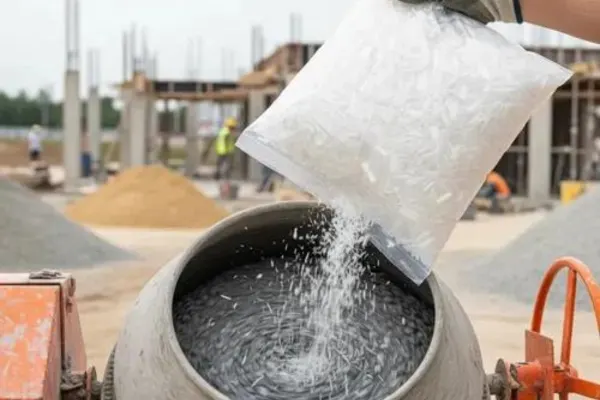
Mixes in cleanly with ready-mix concrete, site-batched mortar, plaster mixes, and thin overlay applications. No special equipment needed — just add it during the standard mixing cycle. It’s compatible with common admixtures like plasticizers and curing compounds without any known interference.
FAQ
Is 8mm fiber better than 10mm for plaster work?
For thinner plaster coats, yes — the shorter length reduces the risk of fiber showing through on the finished surface, while still providing effective shrinkage crack control.
Can this fiber be used in precast panels?
Yes, it’s a popular choice for thin precast elements where early-age shrinkage cracking is a concern but the section thickness doesn’t allow for longer fiber lengths.
Does shorter fiber length mean weaker crack control?
Not really — for shrinkage crack control specifically, fiber length matters less than even dispersion, and 8mm fiber disperses very effectively in thinner sections.