
How Does 6mm Chopped E Glass Fiber Improve Mortar and Render Applications?
Drop the chop length down to 6mm, and glass fiber starts serving a different purpose than it does at 12mm. Instead of structural reinforcement in thick GRC panels, this shorter length is where glass fiber earns its keep in cement-based mortars, renders, and thin repair applications — jobs where a shorter, finer fiber disperses more easily and doesn’t interfere with a smooth finish. As a Glass Fiber Manufacturer, this is one of the sizes we supply heavily to contractors working on plaster reinforcement and fiber-modified mortar formulations.
The shorter length means more individual filaments per kilogram, which translates into finer, more even distribution through a mortar mix — exactly what’s needed when the goal is crack resistance in a thin render coat rather than structural strength in a load-bearing panel.

Product Overview
As a specialized E-Glass Fiber Manufacturer, we chop this fiber to a precise 6mm length with the same cement-compatible sizing applied across our range, ensuring good bonding with the cementitious matrix even in thinner, finer applications. Being an experienced Chopped Glass Fiber Manufacturer, we hold tight control over chop consistency at this shorter length, since even small variances become more noticeable when the fiber is meant to blend into a fine mortar mix.
Technical Specifications
| Glass Type | E Glass |
| Form | Chopped Strand |
| Application | Concrete |
| Tex / GSM | 200 g/m² |
| Sizing Type | Polyester |
| Fiber Length | 6 mm |
| Roll Width | 1000 mm |
| Color | White |
Key Features
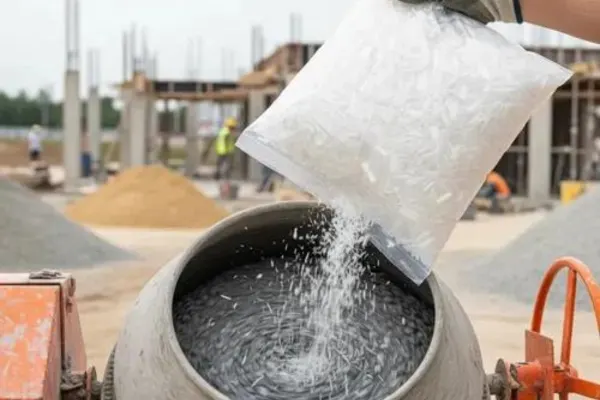
It is free flowing into the mortar or render mix and does not clump due to its short length and even chopping. The fiber is effective in increasing the crack resistance of plaster and renders especially when there is shrinkage cracking due to the application of a thin layer of the cement coating. This is because of the fact that the fiber is compatible with the cement and therefore bonds with the mortar matrix effectively.

Recommended Dosage
In the case of mortars and renders, a fiber quantity of approximately 1-2% by weight of the entire dry mix is advised, although this figure can be adjusted based on the type of render being used and its thickness. In thin mortars used for repairs, dosage may be at the lower end of this figure to maintain workability. It’s worth confirming exact figures with our technical team based on your mortar formulation.
Mixing Compatibility
Compatible with standard cement mortars, polymer-modified renders, and thin repair mix formulations. It mixes in during the standard batching process without needing specialized equipment, and works well alongside common render additives like polymer modifiers and water-retention agents.
FAQ
Is 6mm glass fiber suitable for exterior render applications?
Yes, it’s commonly used in exterior render and plaster work to improve crack resistance, though for applications with sustained high-alkali or wet exposure, AR glass fiber is often the better long-term choice.
Does this fiber affect the smoothness of a render finish?
At recommended dosages, the render finish remains smooth and workable, since the shorter fiber length disperses finely through the mix.
Can 6mm glass fiber be combined with polymer modifiers in render formulations?
Yes, it’s commonly used alongside polymer modifiers in modified render systems without any known compatibility issues.
Need dosage guidance for a mortar or render formulation? Reach out through our enquiry page or check the full range at fiberwellindia.com.